
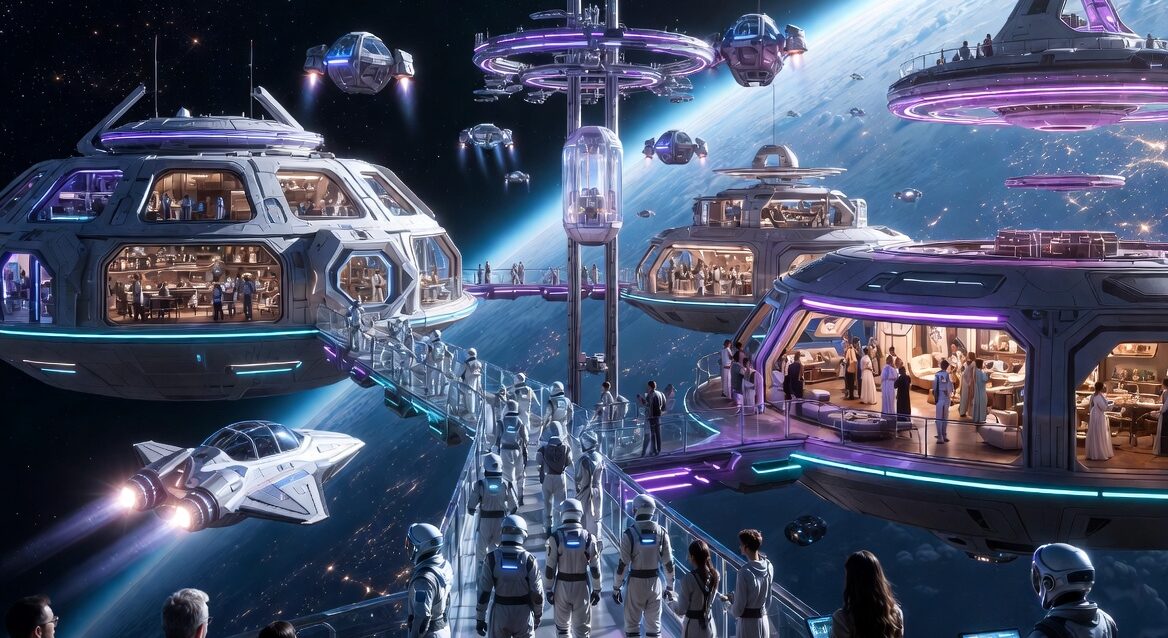
The Future of Travel: Personalized, Low-Carbon Journeys to the Stars
From Carbon-Conscious Journeys to Interplanetary Adventures
As of February 2026, global tourism is rebounding strongly post-pandemic, with leisure travel spending already climbing toward record levels. Forecasts indicate explosive growth: international trips could reach nearly 2.4 billion annually by 2040 (a ~60% increase), leisure travel spending could triple to $15 trillion, and total trips (including domestic) may exceed 30 billion by the mid-2030s. This expansion is driven by rising middle classes (especially in India and Africa), digital tools, and demand for meaningful, sustainable experiences rather than sheer volume.
This case study synthesizes projections from Google/Deloitte, BCG, World Economic Forum, OAG, and industry analyses to outline credible trajectories for how people will move, book, and experience travel over the next 15 years.
1. Near-Term (2026–2030): AI-Personalized, Sustainable, and Proximity-Focused Travel
- Hyper-Personalization via AI
Agentic AI and generative tools design full itineraries in seconds, predicting preferences from past behavior, real-time health data, and mood. Booking lead times shorten dramatically (e.g., Indian travelers already average <50 days). Virtual previews and digital twins let you “test” destinations before committing. - Sustainability Becomes Non-Negotiable
Travelers demand low-carbon options: sustainable aviation fuel (SAF) scales in short-haul flights, electric/hybrid aircraft emerge for regional routes, and carbon tracking is standard. “Slow travel,” domestic/regional trips, and eco-certified accommodations dominate. Proximity models (like 15-minute cities) extend to tourism — more local exploration, fewer long-haul flights. - Electrified & Autonomous Ground Mobility
EVs reach 40–50%+ of sales; shared autonomous pods, eVTOL air taxis, and early hyperloop prototypes cut urban/intercity times. Mobility-as-a-Service (MaaS) apps integrate seamless door-to-door journeys.
2. Medium-Term (2030–2035): Seamless, Low-Emission, and Experience-Driven Mobility
- Advanced Air & Ground Breakthroughs
Electric/hydrogen aircraft enable greener long-haul; supersonic and suborbital flights return with lower emissions. Hyperloop and maglev networks connect major cities at 600+ mph with near-zero emissions. Autonomous vehicles and urban air mobility (flying taxis) make airports obsolete for short hops. - Wellness, Purpose, and Immersive Experiences
Travel shifts toward rejuvenation, adventure, skill-building, and “meaning over mileage.” Wellness tourism explodes (projected $2+ trillion market), with AI-personalized retreats. AR/VR enhances real trips (e.g., digital overlays at sites), while virtual travel grows but drives more physical visits. - New Markets & Hotspots
India becomes a top outbound source (5x growth); Southeast Asia, Middle East (UAE/Saudi), Caribbean, and Africa rise as destinations. Regional travel surges as carbon-conscious choices favor closer, culturally rich spots.
3. Long-Term (2035–2040): Interplanetary Horizons and Regenerative Travel
- Space Tourism Enters Mainstream
Suborbital/orbital flights drop in price; lunar flybys and early orbital hotels become accessible to high-net-worth individuals. Commercial space stations offer “space hotels” for days-long stays. Mars flybys emerge as ultra-premium adventures. - Regenerative & Net-Zero Systems
Full integration of low-carbon tech (hydrogen aircraft, advanced batteries) plus personal carbon allowances. Travel becomes regenerative — offsetting more than it emits via reforestation or tech investments. Borders use biometrics/digital passports; journeys are frictionless. - Blended Real-Virtual Worlds
Digital twins and immersive tech let travelers “visit” inaccessible places, but physical exploration remains prized for authenticity and connection.
Risks & Societal Shifts
- Climate & Inequality — Unchecked growth could overwhelm destinations; carbon pricing may price out lower-income travelers.
- Over-Tourism & Regulation — Hotspots face caps; governments impose limits or fees.
- Privacy & Tech Dependence — AI concierges know intimate details; cyber risks rise.
- Geopolitical & Economic Volatility — Supply chains, energy transitions, and new source markets reshape flows.
Bottom Line
By 2040, travel evolves from mass movement to personalized, sustainable, and transformative experiences. The dominant paradigm becomes AI-orchestrated, low-emission, meaning-focused journeys — blending hyper-local exploration, electrified mobility, immersive tech, and emerging space access. Travel won’t just take you places; it will rejuvenate, educate, and connect you to the planet (and beyond) in ways that prioritize purpose, planet, and personal growth amid unprecedented global expansion. The future of travel is not about going farther — it’s about going deeper.