
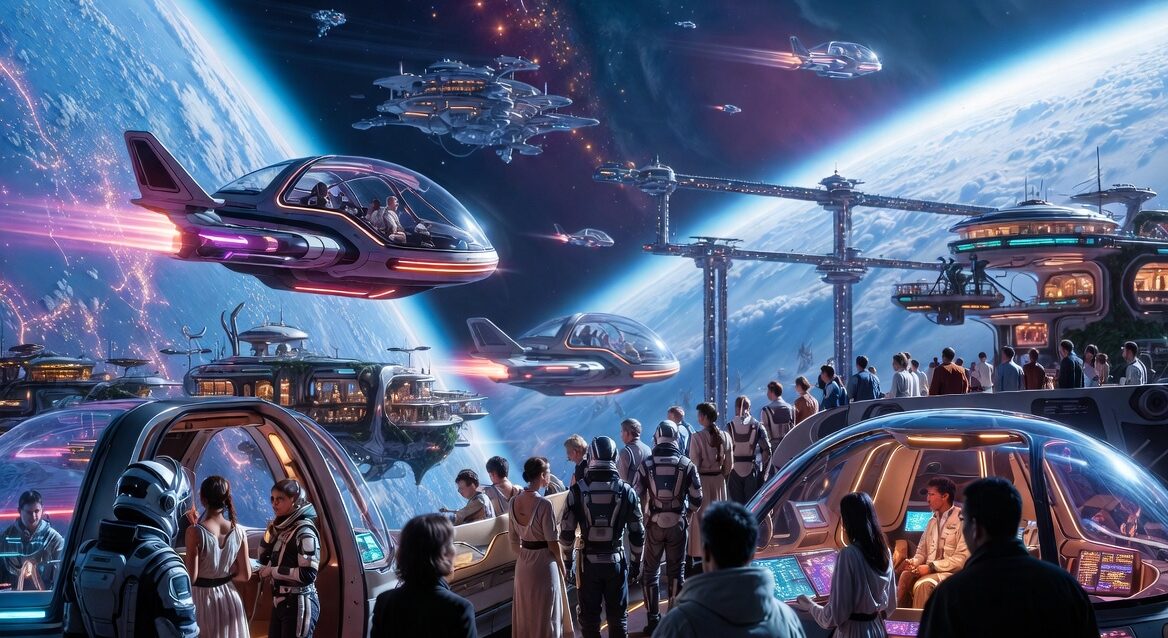
The Next Frontier of Flight: Supersonic Revival and Suborbital Horizons
From Hours to Minutes: Supersonic, Hydrogen, and Suborbital Horizons
As of February 2026, intercontinental travel remains dominated by subsonic jets, with transatlantic flights averaging 7–9 hours and transpacific routes 10–16 hours. Global international trips are rebounding, with projections showing a ~60% increase in international travelers by 2040, reaching nearly 2.4 billion annually. Sustainability pressures intensify as aviation faces net-zero targets (e.g., EU mandates for SAF blends rising to 34% by 2040), while emerging markets (India, China) drive demand growth.
This case study outlines plausible trajectories for transcontinental mobility, drawing from industry forecasts (Google/Deloitte, BCG, IATA), Boom Supersonic developments, Airbus ZEROe/H2 roadmaps, and SpaceX Starship concepts.
1. Near-Term (2026–2030): Greener Conventional + Early Supersonic Revival
- Sustainable Aviation Fuel (SAF) & Efficiency Gains
Airlines blend increasing SAF percentages (2% in 2025 → higher by 2030), cutting lifecycle emissions. New efficient aircraft (e.g., Boeing 777X, Airbus A321XLR) reduce fuel burn on long-haul routes. Transatlantic/transpacific flights stay ~7–15 hours, but carbon tracking and offsets become standard. - Supersonic Return
Boom Overture targets entry into service around 2029–2030 (Mach 1.7, ~60–80 passengers, 100% SAF-compatible). Transatlantic times drop sharply: New York–London in ~3.5–4 hours, New York–Frankfurt in ~4 hours. Initial routes focus on premium/business travelers; fares aim for business-class levels. - Regional Electrification
Hydrogen/electric prototypes emerge for shorter hops, but intercontinental remains jet-fuel reliant.
2. Medium-Term (2030–2035): Hydrogen Breakthroughs & Supersonic Scale
- Hydrogen-Powered Long-Haul
Airbus ZEROe and similar concepts (e.g., hydrogen combustion or fuel cells) target entry around 2035 (delayed from earlier 2035 goals). Early hydrogen aircraft may limit range to medium-haul initially (~2,500–4,000 km), but second-generation designs enable full intercontinental capability with cryogenic tanks. Emissions plummet toward net-zero; transatlantic flights could use hybrid hydrogen/SAF. - Supersonic Networks Expand
Boom Overture scales (orders from United, American, Japan Airlines); viable routes grow to 600+. Multiple carriers operate supersonic fleets, making 3–5 hour transoceanic flights routine for higher-paying passengers. Over-ocean supersonic booms avoided via regulations. - Autonomous & Seamless Integration
AI-orchestrated bookings, biometric borders, and MaaS platforms make continent-hopping frictionless.
3. Long-Term (2035–2040): Suborbital & Ultra-Fast Global Mobility
- Suborbital Point-to-Point
SpaceX Starship’s Earth-to-Earth capability matures. Suborbital trajectories enable anywhere-on-Earth travel in under 1 hour (e.g., New York–Shanghai ~40 minutes, London–Sydney ~30–45 minutes). Launches from offshore platforms; vertical landings near cities. Initial focus: cargo/military (2026–2030 tests), then premium passengers (~2035+). G-forces, safety, and infrastructure challenges addressed. - Regenerative & Net-Zero Dominance
Hydrogen aircraft scale for most intercontinental routes; supersonic uses advanced SAF/hydrogen blends. Full decarbonization via tech + offsets; travel becomes “regenerative” (e.g., investments in carbon removal). - Blended Experiences
Ultra-fast options make day trips feasible; slower, immersive low-carbon cruises or rail-ferry hybrids persist for leisure.
Key Intercontinental Travel Modes by 2040 (Illustrative Comparison)
- Conventional Jet — 7–15 hours, widespread, increasingly SAF/hydrogen-hybrid, affordable mass market.
- Supersonic (Overture-style) — 3–5 hours, premium/business focus, ~Mach 1.7, 100% sustainable fuels.
- Hydrogen Long-Haul — 6–10 hours (improved efficiency), near-zero CO₂, scaling for economy/premium.
- Suborbital (Starship-style) — <1 hour, ultra-premium/adventure, point-to-point anywhere.
Risks & Societal Shifts
- Sustainability & Equity — High-speed options may remain elite; carbon pricing could limit access.
- Regulation & Infrastructure — Supersonic/suborbital need new airspace rules, offshore ports, noise/boom mitigation.
- Safety & Environment — G-forces, radiation exposure (suborbital), contrail impacts require solutions.
- Geopolitical — Emerging markets drive demand; supply chains for H₂/SAF critical.
Bottom Line
By 2040, intercontinental travel transforms from slow, carbon-intensive flights to a multi-speed, low-emission ecosystem. Dominant modes include supersonic for speed, hydrogen for sustainability, and suborbital for ultra-fast global connectivity. Journeys shrink dramatically — hours become minutes for those who can afford it — while sustainability becomes mandatory. The future isn’t just faster travel between continents; it’s redefining distance, accessibility, and responsibility in a hyper-connected world.