
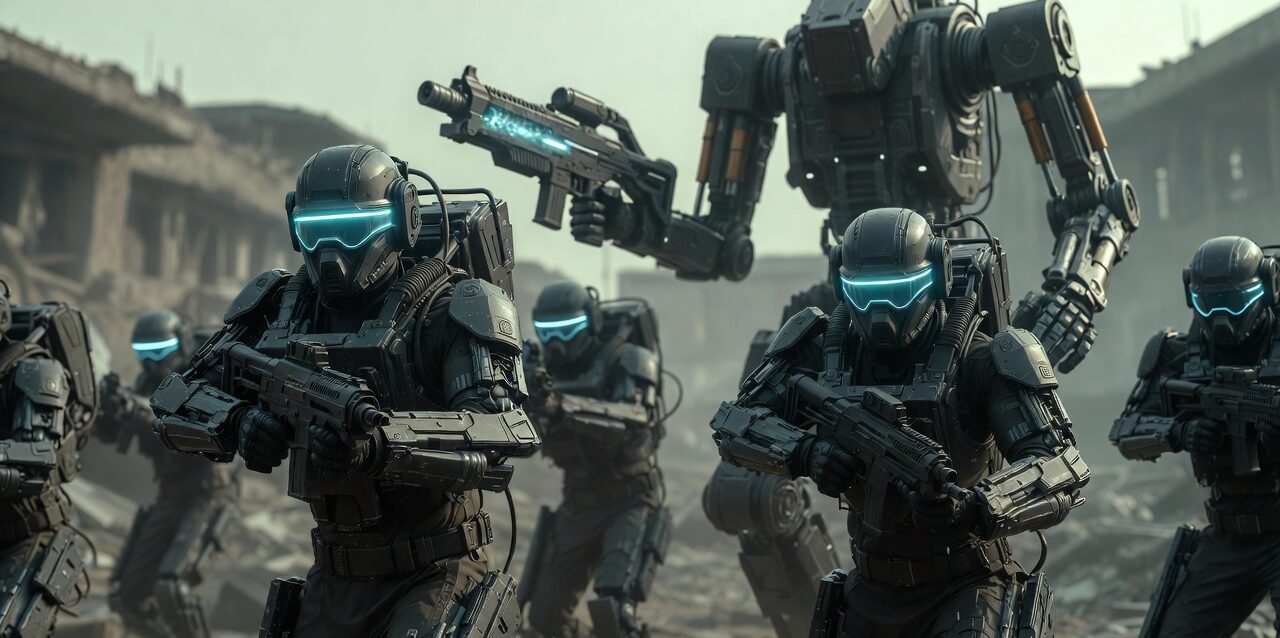
The Weapons Future: AI, Hypersonics, and the End of Human Limits
From Conventional Arms to AI-Driven, Hypersonic, and Multi-Domain Dominance
As of February 2026, weapons technology remains rooted in 20th-century paradigms: kinetic projectiles, guided missiles, armored vehicles, and human-operated systems. The U.S. spends over $800 billion annually on defense, outpacing adversaries, but emerging tech like drones, cyber tools, and hypersonics are reshaping battlefields (e.g., Ukraine conflict). Global forecasts emphasize a shift toward AI autonomy, directed energy, quantum-enabled systems, and biological enhancements, with hypersonic weapons alone projected to reach a market value of $15–20 billion by 2030.
By 2040, weapons technology evolves into intelligent, networked, and multi-domain systems — blending AI, hypersonics, lasers, swarms, and space-based capabilities. Conventional arms persist in hybrid forms, but superiority hinges on speed, precision, autonomy, and resilience against cyber/electronic warfare.
1. Near-Term (2026–2030): AI Integration & Hypersonic Proliferation
- AI and Autonomous Systems Accelerate
AI enhances targeting, decision-making, and drone operations. Autonomous weapons (e.g., loitering munitions with AI target selection) become standard in conflicts. The U.S. and China lead in AI military spending, with swarms of small drones for reconnaissance/strike gaining traction. - Hypersonic Weapons Deploy
Hypersonic glide vehicles and cruise missiles (Mach 5+) enter service: U.S. ARRW, Russia’s Kinzhal/Avangard, China’s DF-17. By 2030, 5–10 nations possess operational hypersonics, challenging traditional missile defenses. - Directed Energy & Cyber Tools
Lasers for counter-drone/rocket defense (U.S. HELIOS) and cyber weapons for disruption mature. Biological enhancements (e.g., gene-editing for soldier resilience) begin trials.
2. Medium-Term (2030–2035): Multi-Domain & Swarm Dominance
- Swarm & Unmanned Systems
Drone swarms (hundreds to thousands) operate autonomously for saturation attacks. U.S. Replicator initiative scales expendable drones; China advances similar tech. Ground robots and unmanned subs integrate for hybrid warfare. - Space-Based & Quantum Weapons
Space weapons (anti-satellite lasers, kinetic interceptors) proliferate. Quantum sensors improve detection; quantum-secure comms counter cyber threats. Directed energy weapons (lasers, microwaves) become vehicle-mounted for air/ground defense. - Biological & Chemical Advances
Gene-editing creates enhanced soldiers (endurance, cognition); synthetic biology enables targeted bioweapons. Ethical debates intensify, with treaties evolving.
3. Long-Term (2035–2040): AI Supremacy & Novel Disruptors
- Full AI Autonomy
Lethal autonomous weapons systems (LAWS) with minimal human oversight dominate. AI directs multi-domain ops (air, land, sea, space, cyber). - Hypersonic & Energy Weapons Scale
Nuclear-armed hypersonics emerge; directed energy becomes primary for missile defense. Railguns and particle beams test viability. - Emerging Frontiers
Nanotech swarms for infiltration/sabotage; neuro-weapons for mind control/disruption. Space-based kinetic rods (“rods from God”) remain conceptual but feasible.
Illustrative Weapons Scenarios by 2040
- Urban Warfare — AI drone swarms overwhelm defenses, with lasers countering incoming threats.
- Naval Battle — Hypersonic missiles strike carriers from 1,000+ km; unmanned subs launch torpedoes autonomously.
- Soldier Enhancement — Gene-edited troops with exoskeletons run faster, endure longer, recover quicker.
- Cyber-Physical Attack — Quantum hacking disables enemy networks; directed energy fries electronics.
Risks & Societal Shifts
- Escalation — Autonomous weapons lower barriers to conflict; AI errors cause unintended casualties.
- Proliferation — Non-state actors access advanced drones/hypersonics via open-source AI.
- Ethics — Ban debates on LAWS/biological weapons intensify; arms races strain economies.
- Inequality — Tech powers widen military gaps between nations.
Bottom Line
By 2040, weapons technology shifts from human-centric platforms to AI-orchestrated, hypersonic, and multi-domain systems — autonomy, speed, and precision redefine warfare. Conventional arms hybridize with tech, but superiority favors integrated AI/swarm/energy capabilities. Weapons won’t just kill — they’ll think, adapt, and dominate across domains. The future isn’t bigger guns — it’s smarter, faster systems that blur lines between defense, offense, and escalation. Societies must balance innovation with ethics to avoid uncontrolled arms races. Warfare becomes less about soldiers and more about silicon.